Canada’s National Parks: From the Rockies to the Arctic
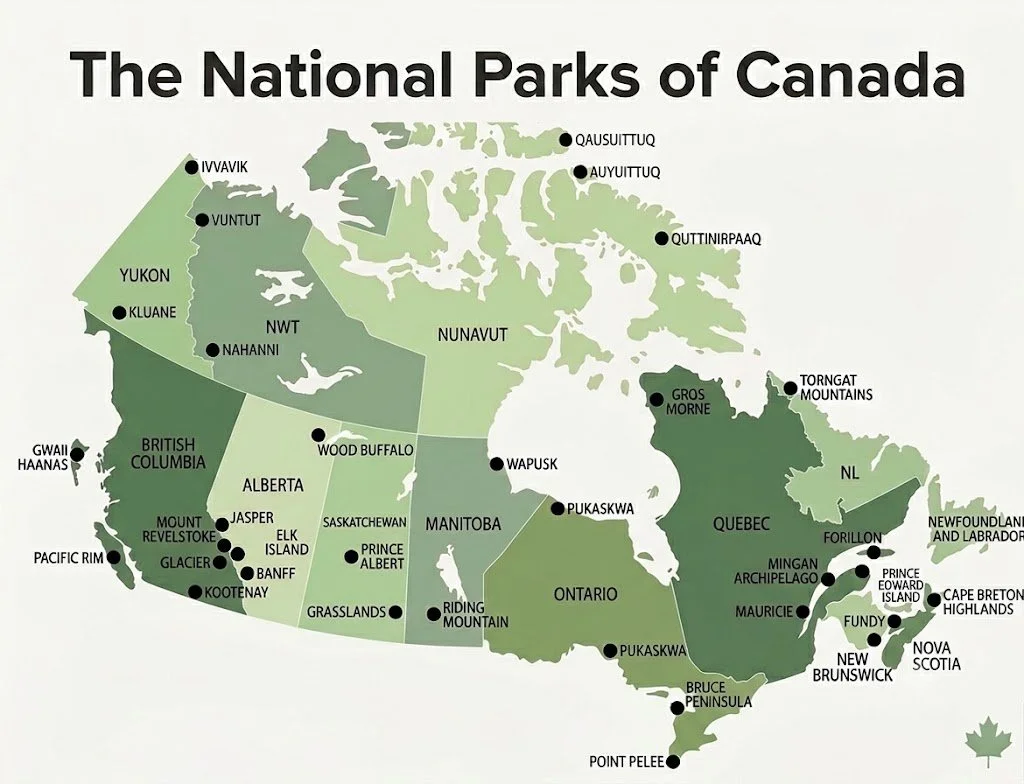
You really can’t have a conversation about Canada without talking about its national parks. While Banff tends to get most of the attention, Canada’s park system stretches from the Pacific Ocean to the Atlantic and all the way into the Arctic. Along the way you’ll find glacier-fed lakes, rainforests, dramatic coastlines, prairie grasslands, fossil beds, and some of the most remote protected landscapes on the continent.
Part of what makes Canada’s national parks so interesting is the sheer variety of landscapes they protect. Some parks certainly share similarities, particularly those in the same region, but the park system as a whole covers everything from towering mountain ranges and turquoise lakes to rugged shorelines and wide-open prairie.
With so much variety, deciding where to start can honestly be the hardest part. If you’re looking for interesting parks to add to your travel list, here are a few that deserve your attention.
Parks to Put on Your Radar
Banff National Park, Alberta
If you’ve ever seen photographs of turquoise lakes surrounded by mountains, there is a good chance you’ve already seen Banff. As Canada’s first national park, Banff is home to places like Lake Louise, Moraine Lake, Peyto Lake, and the Icefields Parkway. It is also one of the easiest parks in the country to visit thanks to its proximity to Calgary and its well-developed visitor facilities.
Best for: Scenic drives, mountain photography, wildlife viewing, and first-time visitors to Canada.
Official website:
https://parks.canada.ca/pn-np/ab/banff
Jasper National Park, Alberta
Just north of Banff, Jasper often feels more spread out and a little quieter. The park is known for its glaciers, waterfalls, alpine lakes, and dark skies. If you enjoy stargazing, Jasper is home to one of the world’s largest accessible dark sky preserves.
Best for: Stargazing, waterfalls, scenic drives, and wildlife viewing.
Official website:
https://parks.canada.ca/pn-np/ab/jasper
Gros Morne National Park, Newfoundland and Labrador
Gros Morne often gets overlooked by international visitors, which is a shame because it has some of the most unique scenery in the country. The park combines fjords, mountains, coastal landscapes, and the Tablelands, an area where rocks from the Earth’s mantle are exposed at the surface.
Best for: Hiking, geology, coastal scenery, and travelers looking for something different from the Rockies.
Official website:
https://parks.canada.ca/pn-np/nl/grosmorne
Cape Breton Highlands National Park, Nova Scotia
A significant portion of the famous Cabot Trail passes through this park, and the combination of mountains and ocean views makes it one of Canada’s great road trip destinations. Visit in autumn and you’ll find some of the country’s most beautiful fall colors.
Best for: Scenic drives, coastal photography, whale watching, and fall foliage.
Official website:
https://parks.canada.ca/pn-np/ns/cbreton
Pacific Rim National Park Reserve, British Columbia
Canada is not all mountains. Pacific Rim protects rugged beaches, old-growth rainforest, and stretches of coastline that feel completely different from the rest of the country. You can spend the morning walking through a rainforest and the afternoon watching surfers along the Pacific coast.
Best for: Beaches, surfing, rainforest walks, and storm watching.
Official website:
https://parks.canada.ca/pn-np/bc/pacificrim
Grasslands National Park, Saskatchewan
This is one of Canada’s least-visited national parks and one of its most underrated. The park protects one of the country’s last remaining sections of native prairie and offers exceptional dark skies, badlands scenery, and opportunities to see wildlife such as bison and pronghorn.
Best for: Dark-sky photography, wildlife viewing, and getting away from crowds.
Official website:
https://parks.canada.ca/pn-np/sk/grasslands
A Few Parks That Don’t Always Get the Attention They Deserve
The Rocky Mountain parks tend to dominate conversations about Canada’s national parks, but some of the country’s most interesting landscapes are found well away from Banff and Lake Louise.
Fundy National Park, New Brunswick
Most people know the Bay of Fundy for having the highest tides in the world, but the national park itself deserves attention too. You’ll find waterfalls, forested hiking trails, scenic lookouts, and opportunities to walk on the ocean floor at low tide.
Best for: Waterfalls, coastal scenery, and shorter hikes.
Official website:
https://parks.canada.ca/pn-np/nb/fundy
Kluane National Park and Reserve, Yukon
This park protects Canada’s highest peak, Mount Logan, along with enormous ice fields and some of the most dramatic mountain scenery in the country. It is also one of those places that reminds you just how much wilderness still exists in Canada.
Best for: Remote scenery, glaciers, photography, and travelers who enjoy places that feel truly wild.
Official website:
https://parks.canada.ca/pn-np/yt/kluane
Waterton Lakes National Park, Alberta
Waterton often gets overshadowed by its larger neighbors, Banff and Jasper, but it has a personality all its own. Here, prairie grasslands meet the Rocky Mountains, creating a landscape that looks noticeably different from other parks in Alberta. It is also part of the world’s first International Peace Park, shared with Glacier National Park in Montana.
Best for: Scenic drives, wildlife viewing, and fewer crowds than Banff.
Official website:
https://parks.canada.ca/pn-np/ab/waterton
Prince Edward Island National Park, Prince Edward Island
This park protects a beautiful stretch of red sandstone cliffs, sandy beaches, dunes, and coastal scenery that feels completely different from western Canada. It is also closely associated with the landscapes that inspired Anne of Green Gables.
Best for: Beaches, cycling, family trips, and coastal photography.
Official website:
https://parks.canada.ca/pn-np/pe/pei-ipe
Nahanni National Park Reserve, Northwest Territories
Reaching Nahanni requires considerably more planning than most Canadian parks, but it is one of the country’s crown jewels. The park is known for its deep canyons, wild rivers, and Virginia Falls, which are nearly twice the height of Niagara Falls.
Best for: Paddling, wilderness adventures, and travelers looking for somewhere few people ever get to experience.
Official website:
https://parks.canada.ca/pn-np/nt/nahanni
Planning a Trip to Canada’s National Parks
Part of what makes Canada’s national parks so appealing is the sheer variety of landscapes they protect. Some parks share similar characteristics, particularly those in the same region, but the park system as a whole covers everything from glacier-fed lakes and towering mountains to rugged coastlines, prairie grasslands, rainforests, and Arctic wilderness.
If you’re thinking about visiting Canada’s national parks, there are a few things that are worth knowing before you start booking flights and mapping out an itinerary.
Canada is a big country, and the parks reflect that. Distances can be substantial, services can vary dramatically from one park to the next, and the experience you’ll have in Banff may be very different from what you’ll encounter in Gros Morne or Nahanni.
None of that is meant to make planning feel complicated. It simply means that a little preparation can go a long way. The more you know before you go, the easier it becomes to choose the parks that fit your interests and make the most of your time once you get there.
A Few Things International Visitors Should Know
Distances are measured in kilometres rather than miles.
Temperatures are reported in Celsius rather than Fahrenheit.
Cell service can become limited or disappear entirely once you get away from populated areas.
Mountain weather can change quickly, even during summer.
Some roads and hiking trails may still have snow well into late spring or early summer.
If you’re renting a car, ask whether your rental includes unlimited kilometres and whether driving on gravel roads is permitted.
One of the biggest mistakes people make is trying to see too much of Canada during one trip. The country is enormous. A drive that looks fairly short on a map can easily turn into a full day once you factor in scenic stops, hiking opportunities, and the simple fact that you’ll probably want to stop and take pictures more than once.
Do Canada’s National Parks Have Entrance Fees?
Most national parks operated by Parks Canada charge an admission fee, although the amount varies by park. If you plan on visiting several parks during your trip, it may make sense to purchase a Parks Canada Discovery Pass, which provides admission to Parks Canada sites across the country for one year.
Because admission fees occasionally change, it is always worth checking the official Parks Canada website before your trip.
Fee information:
https://parks.canada.ca/voyage-travel/admission
Reservations and Planning Ahead
If you’re planning to visit one of Canada’s more popular parks, particularly Banff or Jasper, it pays to think ahead. Campgrounds, lodges, and even certain shuttle services can book up months in advance, especially during the summer travel season.
When Is the Best Time to Visit?
Summer is by far the most popular time to visit Canada’s national parks. Most roads, campgrounds, visitor centers, and hiking trails are open, and the weather is generally the most cooperative.
Fall brings cooler temperatures, beautiful autumn colors, and smaller crowds.
Winter transforms many parks into destinations for skiing, snowshoeing, and winter photography, although snow and icy roads can limit access to certain areas.
Spring can be a wonderful time to visit because waterfalls are often flowing at their strongest and wildlife becomes more active, but weather conditions can still be unpredictable and some services may not yet be operating.
Expect Different Levels of Services
Places like Banff and Jasper have nearby hotels, restaurants, grocery stores, gas stations, and visitor services. Other parks may have only a visitor center and a campground. Some of Canada’s northern parks have very limited infrastructure and require considerably more planning simply to reach them.
Gas stations and services can also be surprisingly far apart in some parts of Canada. If your fuel tank is getting low, don’t assume there will be another station just down the road.
Downloading offline maps before you arrive is also one of the simplest things you can do to make your trip easier. Even some of Canada’s more popular parks have areas where cell service becomes unreliable or disappears altogether.
Keep an Eye on Conditions
Depending on when and where you’re traveling, wildfire smoke can occasionally affect visibility and air quality, particularly in western Canada. It doesn’t happen every year and it doesn’t impact every park, but it is something worth monitoring as your trip approaches.
Depending on where and when you’re visiting, mosquitoes and black flies can also be relentless. Insect repellent may not be the most exciting thing you pack, but you’ll probably be glad you brought it.
One of the nice things about visiting Canada during summer is how much daylight you have to work with. In northern parts of the country, daylight can last well into the evening, giving you extra time for scenic drives, hikes, and photography. The flip side is that it can be easy to lose track of time. A quick stop at an overlook can easily turn into a much longer detour once you start exploring.
Wildlife Is Part of the Experience
Seeing wildlife is often one of the highlights of visiting Canada’s national parks. Depending on where you go, you may encounter elk, moose, mountain goats, bighorn sheep, black bears, grizzly bears, or even whales along the coast.
As exciting as those encounters can be, remember that these are wild animals and should always be treated with respect. Parks Canada recommends maintaining safe distances and never feeding wildlife.
If you plan on doing a lot of hiking in western Canada, particularly in places like Banff, Jasper, Yoho, or Kootenay, carrying bear spray and familiarizing yourself with proper wildlife safety practices beforehand is a good idea.
The Parks Are Bigger Than They Look
One thing that catches a lot of people off guard is that you don’t simply drive into a park and suddenly see everything. Many of Canada’s national parks are enormous. You can spend hours driving through a park and still have plenty left to explore.
One last piece of advice: don’t try to see everything. Pick a region, give yourself time to explore it, and leave room in your schedule to pull over at the overlook you didn’t plan for or take the trail you discovered by accident. Some of the best moments in national parks are the ones you never put on the itinerary.
Helpful Resources
Parks Canada Homepage:
https://parks.canada.ca
Find a National Park:
https://parks.canada.ca/pn-np/recherche-parcs-parks-search
Camping Reservations:
https://reservation.pc.gc.ca